

The Facts About Shisha: Understanding the Difference
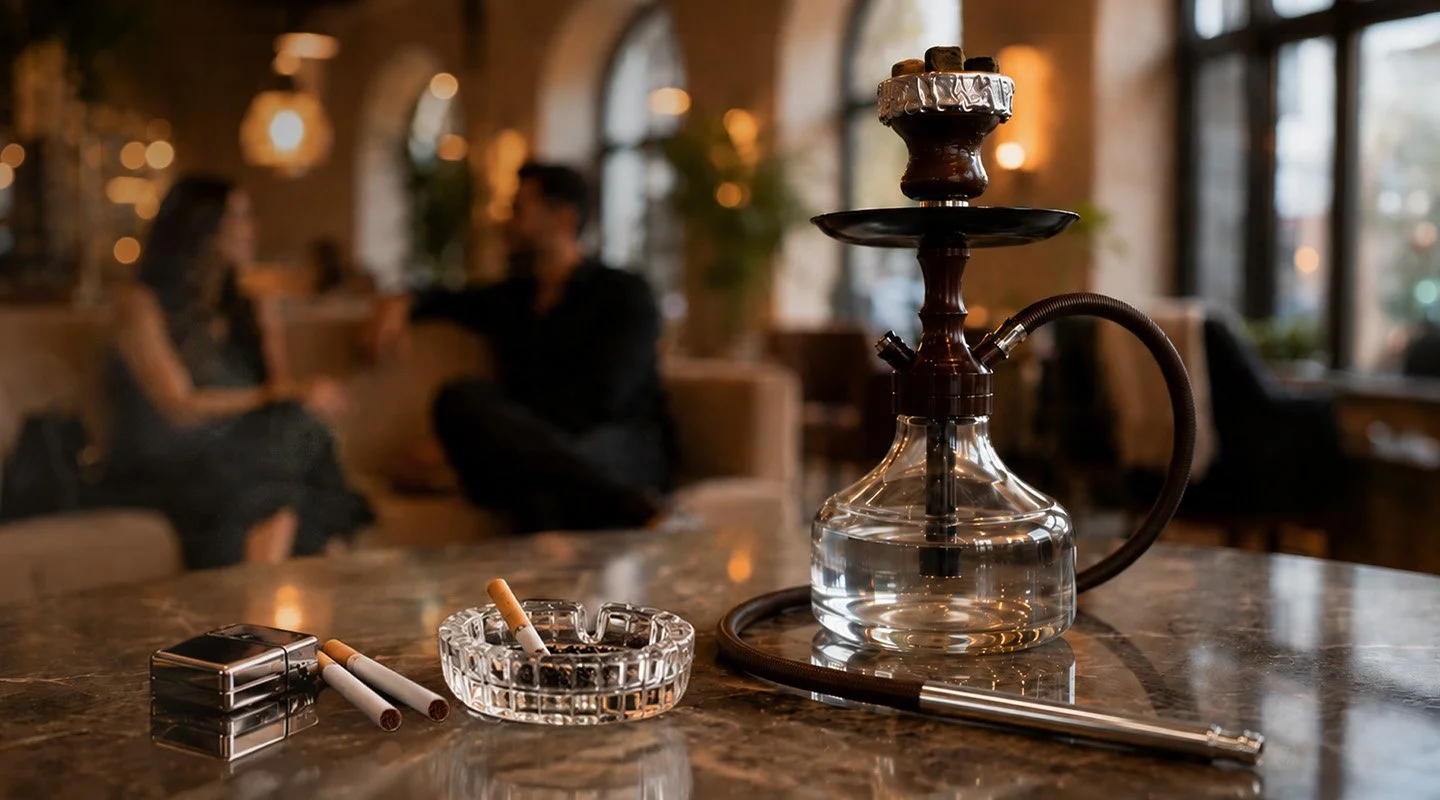
Shisha, also known as hookah or waterpipe tobacco, has been enjoyed for centuries across many cultures. Today, it’s a popular way for friends to gather, relax, and share time together.
Yet, despite its long history, there are still many misunderstandings about what shisha is and its effects. People often assume that smoking shisha/hookah waterpipe tobacco is significantly more harmful than cigarettes since a session may last for an hour or more, but is it really? Let’s take a closer look.
Cigarettes and waterpipes tobacco produce “smoke” in different ways.
The visible smoke from waterpipe tobacco is largely comprised of glycerol and water, whereas cigarette smoke contains thousands of chemical substances produced by the combustion of tobacco (often including additives that control the burn rate).
The difference in the composition of the “smoke” from cigarettes and waterpipe tobacco is best visualised by examining filter pads following collection of the same volume of “smoke” under laboratory conditions.
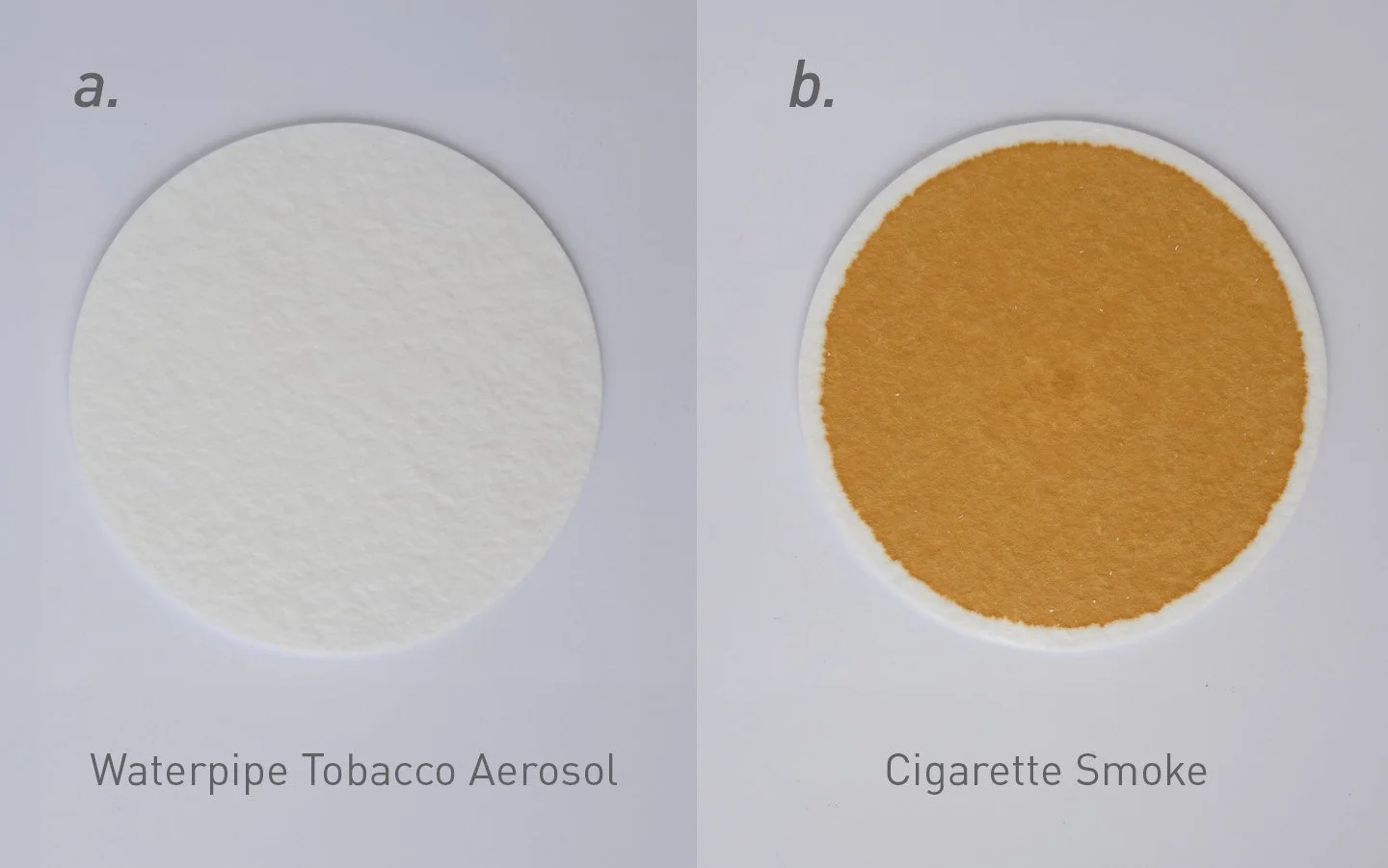
Figure 1. a.) 1925 ml of Al Fakher Two Apples waterpipe tobacco “smoke” collected on a filter pad, and b.) 1925ml of reference cigarette smoke collected on a filter pad showing extensive deposition of by-products of combustion.
Cigarettes burn tobacco at temperatures between 400°C and 900°C, while waterpipe tobacco is heated using charcoal at lower temperatures, typically between 120°C and 190°C.
Despite these differences in process and temperature, both methods still produce harmful chemicals that either already exist in the tobacco or are generated during heating or burning, and these substances are ultimately inhaled by the user.
Usage Patterns
When scientists study the health risks of tobacco products, they need to consider how people use them in real life. For example, research has estimated that people might smoke about two waterpipe sessions per week, compared with around 20 cigarettes per day for cigarette smokers.
Furthermore, a cigarette is generally smoked individually and quickly, usually lasting around 5–7 minutes. Waterpipe sessions are typically longer and more social, often lasting 45-90 minutes, with a single pipe shared among multiple people.
These patterns affect how much nicotine and other harmful chemicals a person is exposed to.
Some people believe that waterpipe tobacco contains much more nicotine than cigarettes, however, research suggests the situation is more complex.
Studies show that the nicotine yield in waterpipe tobacco aerosol can appear higher than cigarette smoke when comparing one session of waterpipe use to one cigarette. But waterpipe sessions usually last much longer and involve many more puffs than smoking a cigarette. When nicotine is measured per puff or per amount inhaled, waterpipes tend to deliver less nicotine than cigarettes, and some newer waterpipe systems deliver even less.
Previous research also suggests that waterpipe users may take in less nicotine and lower amounts of certain harmful chemicals compared with cigarette smokers.
Overall, when typical usage patterns are considered, available research suggests that exposure to harmful chemicals from waterpipe use may be lower than from cigarette smoking. However, this does not mean waterpipe smoking is safe, as it still exposes users to harmful substances.

While both cigarettes and shisha contain tobacco, how they operate are quite different. From the heating process to the composition of the tobacco mixture, shisha and cigarettes are designed in fundamentally different ways.
Understanding these differences helps explain why the two products offer very different experiences for adult consumers.
*Tobacco products, including waterpipes (hookahs), can pose health risks.
BIBLIOGRAPHY
2. Jukema, J. B., Bagnasco, D. E. & Jukema, R. A. Waterpipe smoking: not necessarily less hazardous than cigarette smoking: possible consequences for (cardiovascular) disease. Neth. Heart J. 22, 91–99. (2014).
3. Yadav, S. Decoding waterpipe tobacco smoking: a comprehensive narrative review exploring mechanics, health risks, regulatory challenges, and public health imperatives. Cureus 16, e52168. (2024).
4. Food and Drug Administration. Harmful and potentially harmful constituents in tobacco products and tobacco smoke; established list. Docket no. FDA–2012–N–0143. Fed. Reg. 77 (2012).
5. Primack, B. A. et al. Systematic review and meta-analysis of inhaled toxicants from waterpipe and cigarette smoking. Public. Health Rep. 131, 76–85. (2016).
6.Baker, R. R. Smoke generation inside a burning cigarette: modifying combustion to develop cigarettes that may be less hazardous to health. Prog. Energy Combust. Sci. 32, 373–385.
7.Hertz-Schünemann, R. et al. High-resolution time and spatial imaging of tobacco and its pyrolysis products during a cigarette puff by microprobe sampling photoionisation mass spectrometry. Anal. Bioanal. Chem. 407, 2293–2299. (2015).
8.White, J. L. et al. Effect of pyrolysis temperature on the mutagenicity of tobacco smoke condensate. Food Chem. Toxicol. 39, 499–505. (2001).
9.Shihadeh, A. et al. Toxicant content, physical properties and biological activity of waterpipe tobacco smoke and its tobacco-free alternatives. Tob. Control 24, i22–i30. (2015).
10.Monzer, B., Sepetdjian, E., Saliba, N. & Shihadeh, A. Charcoal emissions as a source of CO and carcinogenic PAH in mainstream narghile waterpipe smoke. Food Chem. Toxicol. 46, 2991–2995. (2008).
11. Sepetdjian, E. et al. Phenolic compounds in particles of mainstream waterpipe smoke. Nicotine Tob. Res. 15, 1107–1112. (2012).
12. Monzer, B., Sepetdjian, E., Saliba, N. & Shihadeh, A. Charcoal emissions as a source of CO and carcinogenic PAH in mainstream narghile waterpipe smoke. Food Chem. Toxicol. 46, 2991–2995. (2008).
13. El Hourani, M. et al. Comparison of CO, PAH, nicotine, and aldehyde emissions in waterpipe tobacco smoke generated using electrical and charcoal heating methods. Chem. Res. Toxicol. 32, 1235–1240. (2019).
14. Deutsche Bundesinstitut fur Riskobewertung. Frequently asked questions about waterpipes https://www.bfr.bund.de/en/service/frequently-asked-questions/topic/frequently-asked-questions-about-water-pipes/ (2018).
15. Staal, Y. C. M., Bos, P. M. J. & Talhout, R. Methodological approaches for risk assessment of tobacco and related products. Toxics (2022).
16. Wilkinson, P.J., Clarke, A., Fearon, I., Barry, R. Emissions from conventional and electronic waterpipes relative to cigarettes and a heated tobacco product. Scientific Reports | 15:14176 (2025).
17. Lüdicke, F. et al. Effects of switching to a heat-not-burn tobacco product on biologically relevant biomarkers to assess a candidate modified risk tobacco product: a randomized trial. Cancer Epidemiol. Biomarkers Prev. 28, 1934–1943. (2019).
18. World Health Organization. Tobacco Free Initiative. The truth about waterpipe use. https://www.emro.who.int/tfi/know-the-truth/waterpipe-tobacco-use.html (2024).
19. Etemadi, A. et al. Urinary biomarkers of carcinogenic exposure among cigarette, waterpipe, and smokeless tobacco users and never users of tobacco in the Golestan cohort study. Cancer Epidemiol. Biomark. Prev. 28, 337–347. (2019).
20. Jacob, P., et al. Comparison of nicotine and carcinogen exposure with water pipe and cigarette smoking. Cancer Epidemiol. Biomarkers Prev. 22, 765–772. (2013).
21. Kaplan, B. et al. Waterpipe tobacco smoke: characterization of toxicants and exposure biomarkers in a cross-sectional study of waterpipe employees. Environ. Int. 127, 495–502. h (2019).
22. Primack, B. A. et al. Comparison of toxicant load from waterpipe and cigarette tobacco smoking among young adults in the USA.Tob. Control. 054226 (2018).